
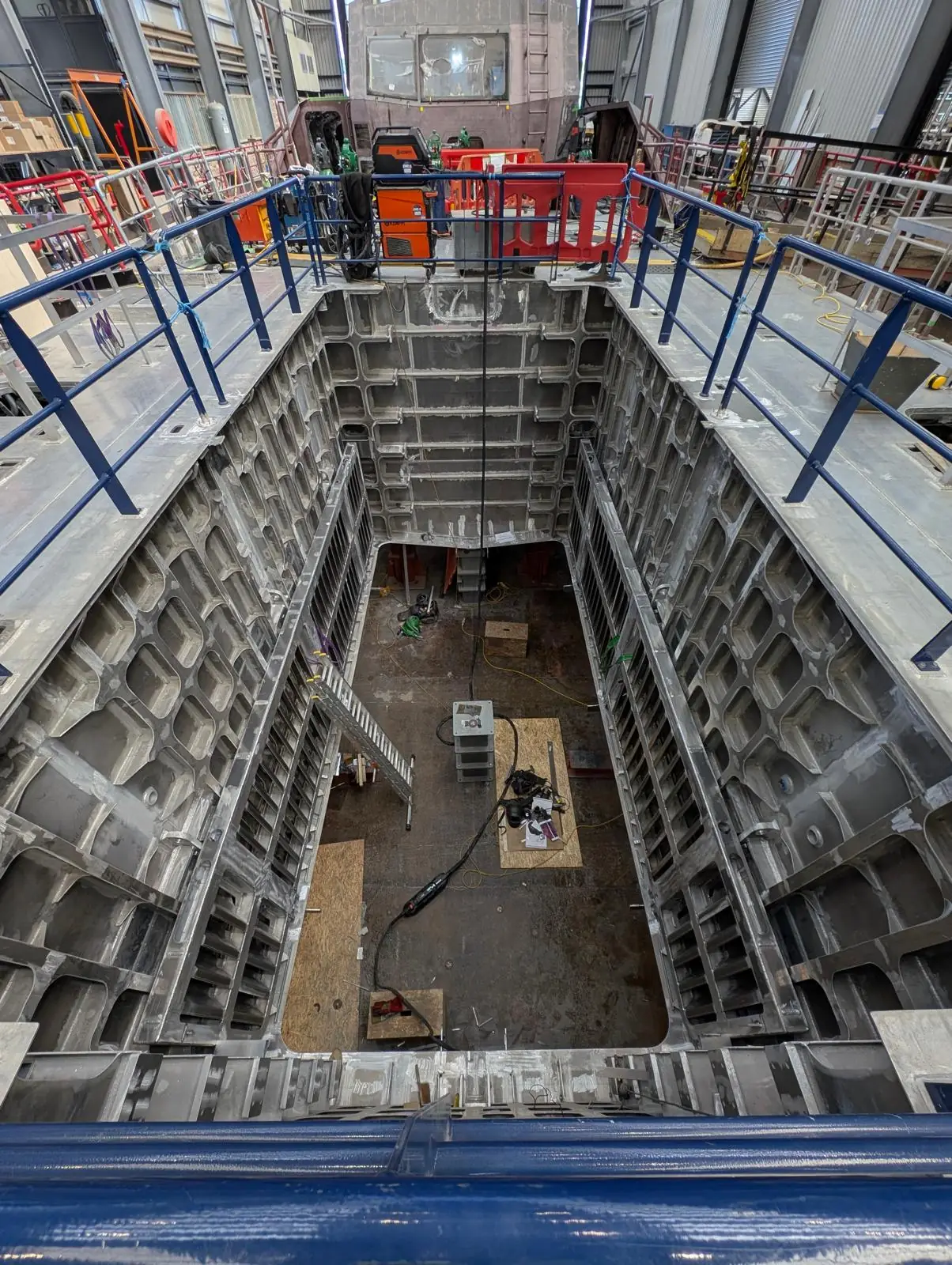
The short answer
A moonpool, also written moon pool, is a vertical opening through the hull of a ship or platform that is open to the sea at the bottom and to the air at the top. Crews use it to lower and recover equipment such as diving bells, ROVs, drill strings and survey tools without working over the side of the vessel.
How a moonpool works
A moonpool is a watertight shaft, often called the moonpool trunk, built through the vessel from the keel up to a working deck. The walls of the trunk are part of the hull structure, so the rest of the ship stays dry while seawater fills the shaft up to the waterline.
Equipment is lifted by a crane, winch or handling system above the shaft and lowered straight down through the water inside the trunk. Because the moonpool sits inside the hull, the equipment passes through calmer water than it would at the ship side.
Why vessels use a moonpool
Launching equipment over the side exposes it to waves, wind and the full roll of the vessel. A moonpool is usually placed near the centre of the ship, where vertical and rolling motion is smallest, so equipment can be deployed and recovered in rougher weather.
The shaft also protects lifting wires, umbilicals and people from the open sea. That allows longer operating windows, safer handling and, on research and polar vessels, deployment of instruments when the sea surface is covered in ice.
Which ships have a moonpool
Moonpools are common on drillships and semi-submersible drilling units, where the drill string passes through the opening. Dive support vessels use them to launch saturation diving bells, and offshore construction vessels use them for ROVs, subsea tools and cable or pipe handling.
Research vessels, survey vessels and some specialised fishing and subsea mining vessels also have moonpools. Size ranges from a small shaft for a sensor to large openings of several metres for drilling or construction work.
Why the ship does not sink
The water in a moonpool rises only to the same level as the sea outside, which is the vessel waterline. Buoyancy comes from the watertight hull around the shaft, so the open trunk does not let water into the rest of the ship.
Designers do need to account for water moving up and down inside the shaft. In waves, the water column can oscillate in a piston mode or slosh from side to side, which affects deck clearance, equipment handling and the loads on the trunk structure.
The drawback: drag during transit
An open moonpool disturbs the flow along the bottom of the hull. While the vessel sails, water enters and leaves the opening, which increases hydrodynamic resistance and therefore fuel consumption and emissions.
Common measures are damping devices inside the trunk, carefully shaped openings and moonpool bottom doors. Bottom doors close the opening flush with the hull, so the vessel sails with a smooth bottom when the moonpool is not in use.
Moonpool doors and moonpool hatches
A moonpool door closes the shaft at keel level. It is usually hydraulically operated, locked in the closed position and fitted with position feedback, so the bridge or control room knows whether the door is open, closed and locked.
A moonpool hatch cover closes the top of the shaft at deck level. It keeps people and equipment from falling into the opening and protects the working deck from water rising in the trunk. Many vessels use both: doors at the bottom for transit and hatches at the top for safe deck work.
Both are engineered to the moonpool geometry and approved by the classification society of the vessel, such as DNV, ABS, Lloyd’s Register or Bureau Veritas.